Are Essix, Hawley, Vivera and Bonded Retainers VAT Exempt in the UK?
The answer is different for each type, and none of them is automatic

Quick Answer
No retainer type is automatically VAT exempt in the UK, and none is automatically standard-rated either. The 2026 Upper Tribunal decision in HMRC v Align Technology Switzerland GmbH found that the clear aligners in that case were not VAT-exempt dental prostheses, but it was a ruling about aligners, not about Essix, Hawley, Vivera or bonded retainers. What matters is function: a denture, crown or bridge replaces a missing tooth, while a retainer normally holds teeth that are already there. That distinction is why every retainer type needs reviewing on its own facts rather than by its product name.
Since the July 2026 aligner judgment, UK dental laboratories, practices and patients have all been asking the same question in slightly different words: does this apply to my retainer? The honest answer is that the ruling did not decide it, and that product names are a poor guide to VAT treatment. This page works through the common retainer types one at a time. If you want the underlying law and the classification framework rather than the type-by-type answers, that is covered in our main guide to VAT on dental retainers in the UK.
The short answer, by retainer type
| Retainer type | What it normally does | Is the VAT position automatic? |
|---|---|---|
| Essix retainer | A clear plastic shell that holds teeth in their post-treatment position. | Not automatic Function is retentive, not prosthetic, but the supply and the exemption conditions still have to be reviewed. |
| Hawley retainer | An acrylic plate with wire components that maintains tooth position. | Not automatic Material and appearance do not decide VAT treatment. A Hawley carrying a temporary tooth is a different question. |
| Vivera retainer | A branded clear retainer associated with the Invisalign system, used after treatment. | Not automatic Brand name does not determine liability. Do not assume a Vivera retainer is treated like an Invisalign aligner. |
| Bonded retainer | A fixed wire attached behind the teeth to maintain alignment. | Not automatic The appliance and the clinical fitting service may need to be considered as separate supplies. |
| Retainer with a pontic or temporary tooth | Retains the existing teeth while also replacing the appearance of a missing one. | Not automatic The replacement function may require a different analysis from an ordinary retainer. |
This is a practical guide, not a VAT ruling. The same product name is used in very different supply arrangements, and a single dental invoice may contain more than one type of supply.
Why the question is about function, not product name
On 7 July 2026 the Upper Tribunal allowed HMRC's appeal in HM Revenue and Customs v Align Technology Switzerland GmbH, holding that the clear aligners in that case were not dental prostheses within Items 2 and 2A of Group 7 to Schedule 9 of the Value Added Tax Act 1994. The reasoning turned on the ordinary meaning of a prosthesis as an artificial replacement for part of the body. The aligners moved teeth that were already present; they did not replace anything.
That reasoning is what reaches beyond aligners. It does not classify every other appliance, but it makes an appliance's purpose the decisive question. HMRC's own guidance on dental prostheses still lists partial and full dentures, fixed and removable bridges, crowns and inlays, obturators, splints and other specially designed appliances, dental plates and individual artificial teeth among its examples of exempt goods when the relevant conditions are met. The Dental Technologists Association has made the same point from the laboratory side, cautioning that the decision relates specifically to the clear orthodontic aligners considered in the case and that laboratories should look at the nature and purpose of each product rather than assuming every orthodontic appliance shares one treatment.
The full case history, the prosthesis-versus-appliance framework and what the judgment means for laboratory pricing, registration thresholds and historic returns are all set out in the main VAT guide. The rest of this page applies that thinking to individual retainer types.
Is an Essix retainer VAT exempt?
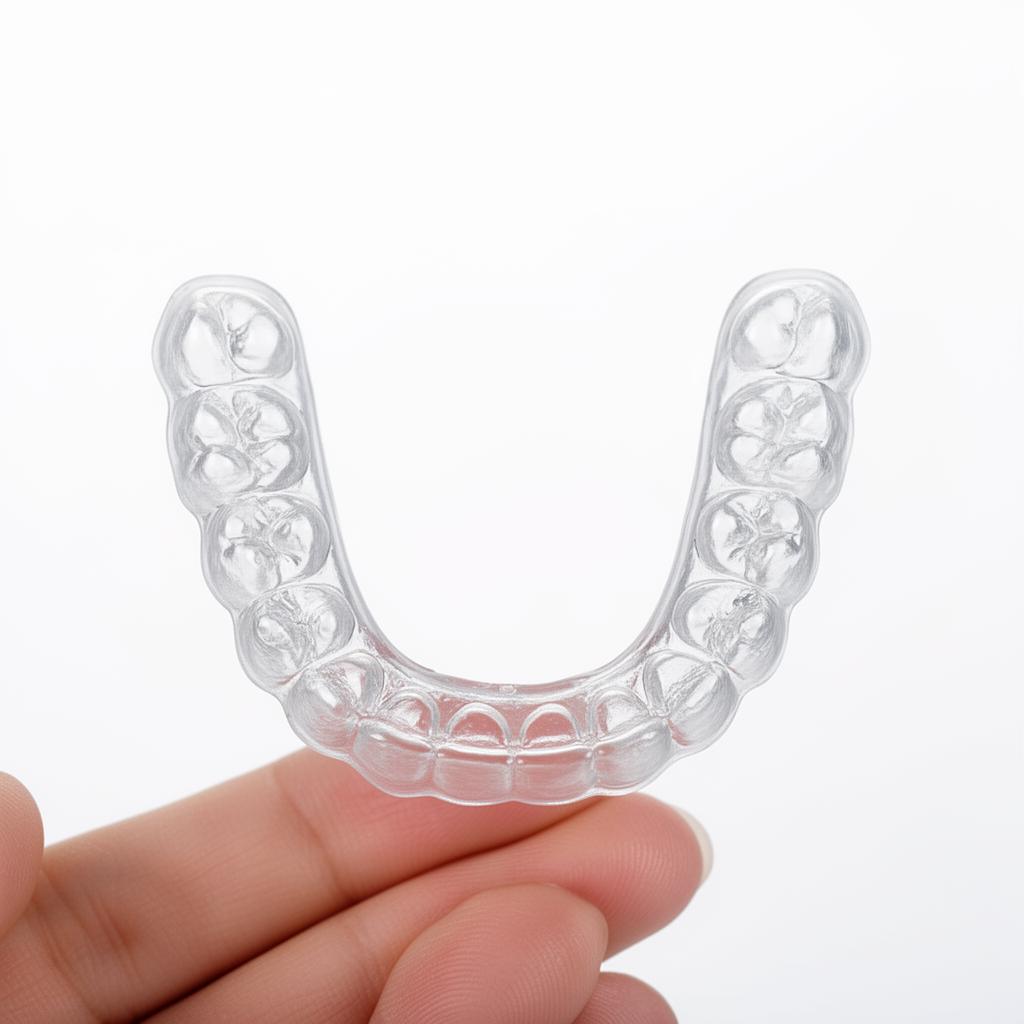
An Essix retainer is a clear, removable plastic retainer vacuum formed to fit over the teeth, normally worn after orthodontic treatment to hold the result in place. Its defining feature for VAT purposes is what it does: it holds existing teeth in position. It is not designed to replace a missing tooth the way a denture, bridge or artificial tooth is.
That functional distinction means a laboratory should not assume an ordinary Essix retainer qualifies for the traditional dental prosthesis exemption simply because it is custom made to a prescription. Custom manufacture is not the test.
At the same time, the 2026 decision concerned clear aligners, not Essix retainers, so it would be overstating things to say the ruling made every Essix retainer standard-rated. The correct approach is a review of the product's design, its intended function, the supply arrangement and the applicable HMRC guidance. If you want to understand how Essix retainers differ from the other clear retainers on the market, our guide to Essix retainers versus other clear retainers covers the materials and manufacturing.
Is a Hawley retainer VAT exempt?
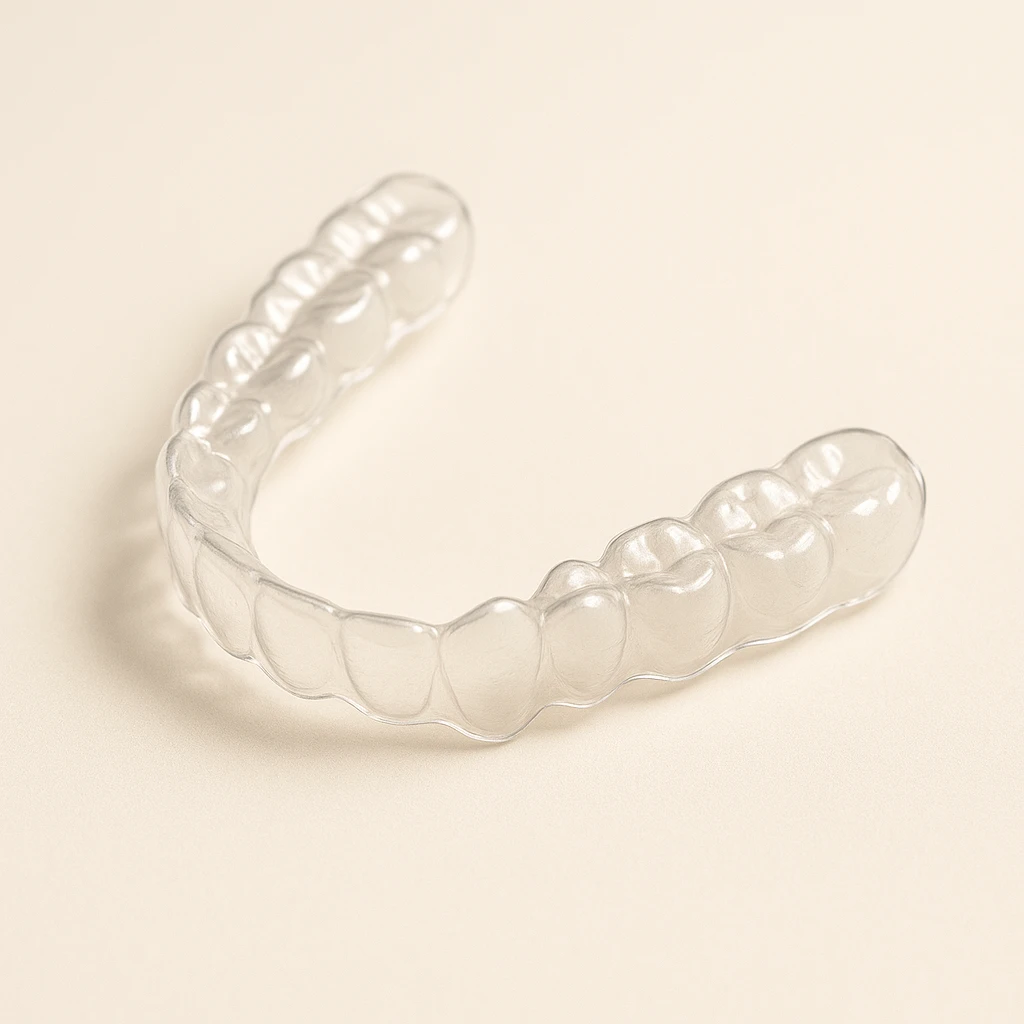
A Hawley retainer combines an acrylic plate with a visible wire that maintains the position of the teeth. It is removable and is commonly fitted after orthodontic treatment. The fact that it uses acrylic and metal rather than clear thermoplastic does not change the analysis at all: material is not the test any more than brand or price is.
The same functional question applies. Is this Hawley appliance replacing a missing or damaged tooth, or is it primarily retaining teeth that are already present? An ordinary post-treatment Hawley retainer would be described clinically as a retentive appliance, which makes it a product for careful classification rather than one that drops automatically into the denture, bridge or artificial tooth category.
There is a genuine complication here, though. HMRC's guidance lists splints and other specially designed appliances among potential exempt examples, so a laboratory should consider the full facts rather than treating the word "retainer" as conclusive. And a Hawley appliance built with a temporary replacement tooth is materially different from a plain retentive one, so it should not inherit the same classification without thought.
Is a Vivera retainer VAT exempt?
Vivera retainers are branded clear retainers associated with the Invisalign system, intended to maintain tooth position after treatment finishes. Because they share a manufacturer and a clear thermoplastic design with Invisalign aligners, they are frequently assumed to share the aligners' VAT treatment as well. That assumption is worth resisting.
The Align case was about clear orthodontic aligners used to move teeth. A Vivera retainer is marketed for retention after the teeth have already been moved. That difference is real and relevant, but it does not create an automatic exemption in the other direction either. VAT treatment still depends on the actual supply and on the applicable legal and HMRC rules, and the Dental Technologists Association has specifically warned that not all orthodontic appliances necessarily share one treatment.
In practice, some UK dental practices and laboratories have already announced that VAT will be added to applicable charges for Invisalign and Vivera. If you are quoted for Vivera retainers, check the date of the invoice, whether the charge comes from the laboratory or the practice, and whether the displayed figure is VAT inclusive. Do not assume one provider's treatment applies to every Vivera supply in the UK. Our page on Vivera retainers and the alternatives covers how they are ordered and what else is available.
Is a bonded retainer VAT exempt?
A bonded retainer, sometimes called a fixed or permanent retainer, is a wire attached to the back of the teeth so that alignment is maintained without the patient removing anything at night.
Bonded retainers raise a supply question that removable retainers do not. The patient may be paying for the physical wire and, separately, for the professional service of fitting, bonding and checking it. Those elements may need to be analysed separately, because a qualifying dental service and a physical dental appliance are not necessarily treated identically for VAT purposes.
The 2026 Align decision did not decide the treatment of bonded retainers, so it would be misleading to claim the judgment makes them standard-rated. A practice or laboratory should consider what has actually been supplied, who supplied it, whether the wire forms part of a clinical service, and how the charge is documented.
If you are a patient, the more useful question than "is this VAT free" is an itemised one: ask the practice what the charge covers, whether VAT is included in it, and whether fitting, follow-up appointments, repairs or replacement of the wire are part of the same fee.
What about a retainer with a false tooth in it?
Some retainers carry a pontic, a temporary tooth built into the appliance to improve appearance while a patient waits for a more permanent restoration. This is the most interesting edge case on the list, because the appliance genuinely performs two functions at once. It retains the existing teeth, and it also replaces the visible appearance of a missing one.
That does not make the whole appliance automatically exempt. It means the replacement function has to be considered carefully alongside the retentive function, the design of the appliance and the contractual supply. A laboratory or practice should obtain specific advice rather than applying the classification it uses for an ordinary Essix or Hawley retainer.
The case illustrates the wider point on this page. Two appliances can both be called retainers and perform materially different jobs, which is exactly why product names are unreliable as a VAT shortcut.
How to check whether a retainer price includes VAT
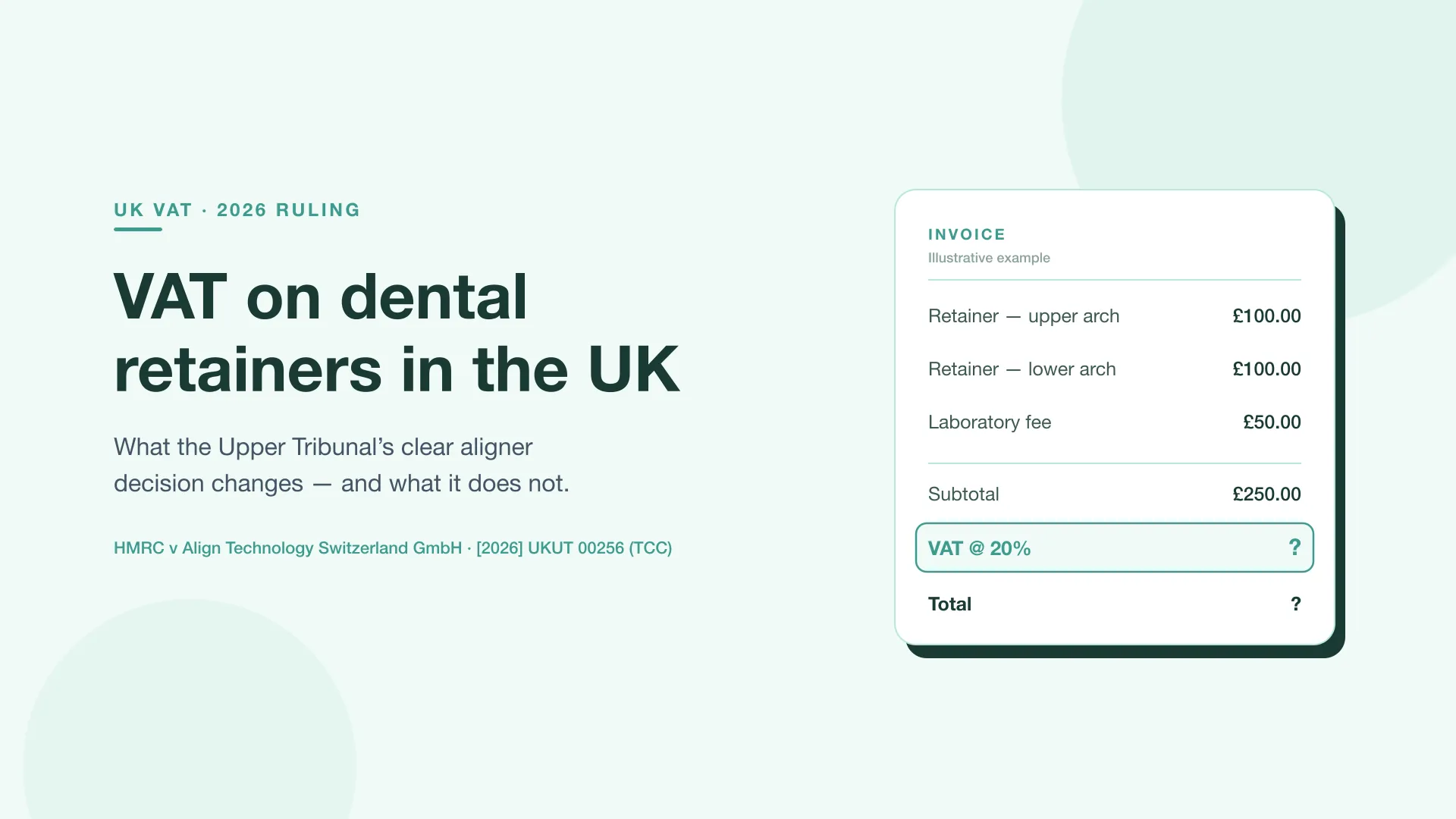
The current UK standard rate of VAT is 20%, so the difference between a VAT-inclusive and a VAT-exclusive quote is substantial. A £100 VAT-inclusive price is not the same offer as a £100 price before VAT, and consumer prices should be compared on a like-for-like basis. Before ordering, it is worth asking a supplier the following.
| Question to ask | Why it matters |
|---|---|
| Is the displayed price inclusive of VAT? | It tells you the actual amount you will be charged, not a net figure. |
| Is the price for one arch, two arches, or several retainers? | Retainer pricing varies with quantity and coverage, so headline prices are rarely comparable. |
| Is the impression kit included? | Some online suppliers include it in the price and others charge for it separately. |
| Is delivery included? | Postage can change the real total significantly on a lower-priced order. |
| What happens if the impression or the finished retainer does not fit? | A remake or refit policy matters more when you are ordering remotely. |
| Is the charge coming from a dentist, a laboratory or an online supplier? | The supply chain can affect how the VAT question is analysed. |
A provider cannot give you personal tax advice, but it should be able to explain plainly what is included in its price and whether the figure you see is the figure you pay. For a wider comparison across dentists, orthodontists and online providers, see how much retainers cost in the UK. If you are replacing a lost or damaged appliance, our guide to replacement retainers and whether you need to see a dentist covers the practical route.
If you run a dental laboratory or practice
The short version is that the responsible step is a documented, product-by-product review rather than applying one rate across a catalogue, and that no laboratory should copy another laboratory's VAT codes, because two businesses can have different contracts, supply chains and product designs.
The detail, covering what a defensible review should record, input tax recovery and partial exemption, the £90,000 registration threshold and the question of historic exposure, is set out in the main VAT guide for dental laboratories and practices. Confirm your own position with HMRC or a qualified UK VAT adviser before changing invoices, prices, registration or historic returns.
The bottom line on retainers and VAT
No retainer type is automatically VAT exempt or automatically standard-rated. The name of the appliance does not settle the question.
The 2026 Upper Tribunal decision established that the clear aligners in the Align case were not VAT-exempt dental prostheses. It did not rule on Essix, Hawley, Vivera or bonded retainers.
Essix, Hawley and Vivera retainers normally retain existing teeth rather than replacing a missing one. A bonded retainer does too, but its supply may split into an appliance and a clinical service.
A retainer carrying a pontic or temporary tooth performs a replacement function as well as a retentive one, and should be analysed on its own facts.
For patients: check whether the quoted price includes VAT and exactly what it covers. VAT status says nothing about how well an appliance is made.
Frequently asked questions
Are Essix retainers VAT exempt in the UK?
Not automatically. An Essix retainer normally holds existing teeth in the position they finished orthodontic treatment in, rather than replacing a missing or damaged tooth. That function does not sit comfortably inside the traditional dental-prosthesis description in HMRC's guidance, so a laboratory should not assume exemption simply because the appliance is custom made. The 2026 clear aligner ruling is relevant background but it did not decide the position for Essix retainers.
Are Hawley retainers VAT exempt?
There is no universal answer based on the Hawley design alone. Acrylic and wire construction does not decide VAT treatment any more than clear plastic does. A standard retentive Hawley appliance and a Hawley appliance carrying a temporary replacement tooth may need different analysis, because one retains existing teeth and the other also replaces a missing one.
Are Vivera retainers VAT exempt?
The Vivera brand name does not determine VAT liability. Vivera retainers should not be treated as identical to Invisalign clear aligners just because both come from the same manufacturer and use a clear thermoplastic shell. Aligners move teeth; retainers are intended to hold them. That difference is genuine, but it does not create an automatic exemption, and some UK practices and laboratories have already said they will add VAT to applicable Invisalign and Vivera charges.
Are bonded retainers VAT exempt?
The 2026 Tribunal decision did not decide bonded retainers. A bonded retainer also raises a second question that removable retainers do not, because the patient may be paying for both a physical wire and the professional service of bonding, checking and repairing it. A qualifying dental service and a physical dental appliance are not necessarily treated the same way for VAT, so the elements may need to be considered separately.
What about a retainer with a false tooth or pontic in it?
This is the clearest edge case. An appliance that both holds the existing teeth and replaces the visible appearance of a missing tooth is performing two functions, one retentive and one replacement. That does not make the whole appliance automatically exempt, but it does mean the replacement element should be considered on its own facts rather than classified like an ordinary Essix or Hawley retainer.
Does VAT status tell me anything about how good a retainer is?
No. VAT is a tax classification, not a quality rating. It says nothing about the material, the fit, the manufacturing standards or the clinical suitability of an appliance. Judge a retainer on the laboratory that makes it, the material it is made from, how the impression or scan is taken, and what happens if it does not fit.
About Retainers at Home
Retainers at Home supplies custom clear retainers made in a UK dental laboratory, ordered online from impressions you take at home. You can see how custom clear retainers work, read the at-home dental impression instructions, or browse the clear retainer FAQs for questions about fit, delivery and aftercare.
Custom clear retainers, made in a UK dental lab
Take your impressions at home. We make your retainers and post them to your door.
Shop Clear RetainersSources
- [2026] UKUT 00256 (TCC) HM Revenue and Customs v Align Technology Switzerland GmbH, GOV.UK
- VATHLT2490: Dentists: Dental prostheses, HMRC internal manual, GOV.UK
- VAT and Orthodontic Aligners: What Dental Laboratories Need to Know, Dental Technologists Association
- Health professionals and pharmaceutical products (VAT Notice 701/57), GOV.UK
- VAT rates on different goods and services, GOV.UK
Last reviewed 20 September 2026. UK VAT guidance, tribunal decisions and HMRC practice can change. This page is reviewed when HMRC publishes further clarification or the case progresses.