VAT on Dental Retainers in the UK
What the 2026 Aligner Ruling Changes — and What It Does Not
Quick Answer
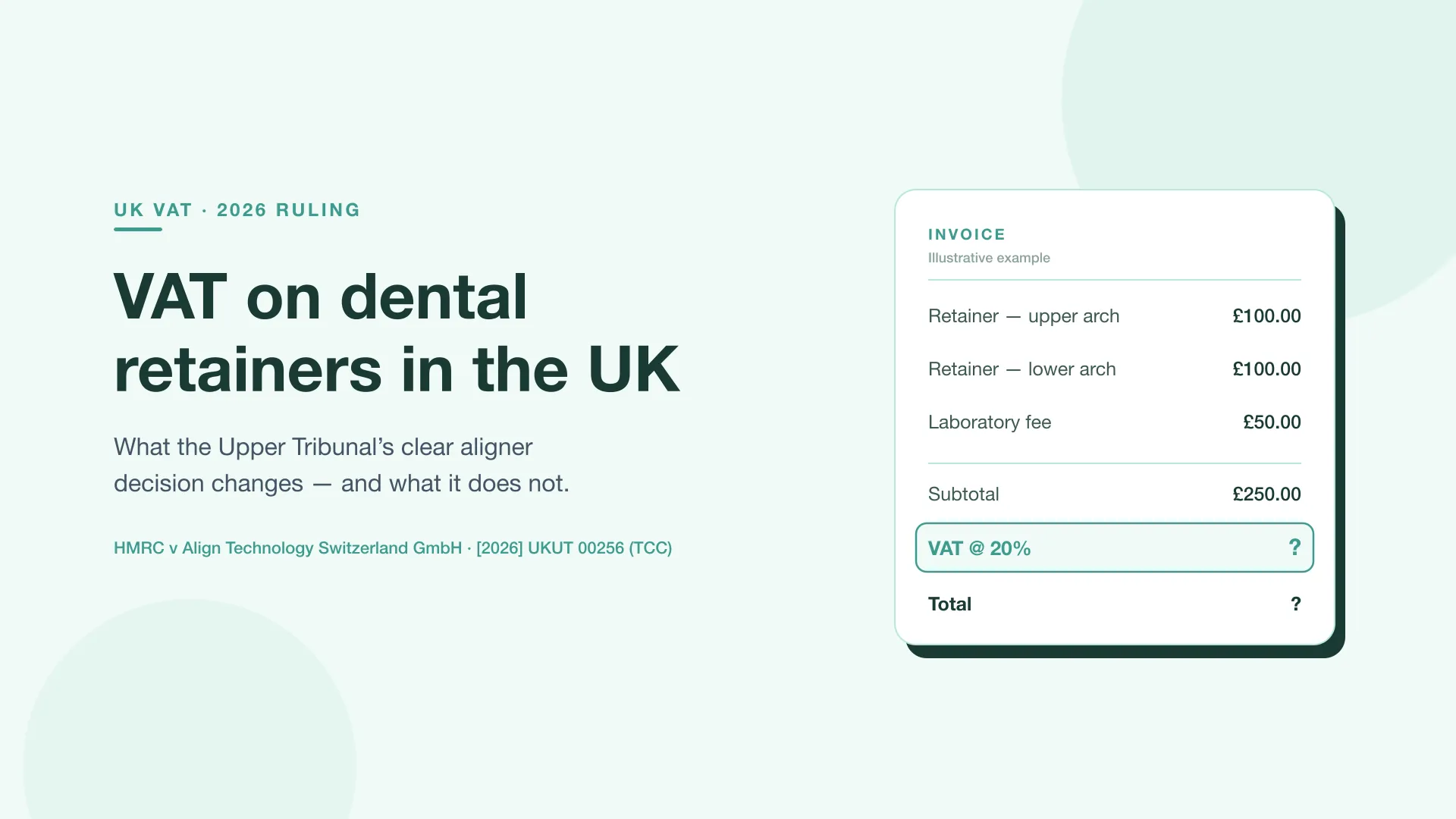
Are dental retainers subject to VAT in the UK? There is no blanket answer. On 7 July 2026 the Upper Tribunal decided that Invisalign-style clear aligners are not VAT-exempt dental prostheses, because a prosthesis replaces a missing or damaged tooth while an aligner moves teeth that are already there. That decision was about aligners, not retainers. But most removable retainers hold existing teeth in position rather than replacing anything, so the same functional reasoning may matter to them. VAT liability now turns on what an appliance actually does, who supplies it and to whom — not on what the product is called.
The UK's 2026 VAT ruling on clear orthodontic aligners has changed the conversation around every removable dental appliance, retainers included. This guide explains what the Upper Tribunal actually decided, why the reasoning reaches beyond aligners, what it means for dental laboratories and practices, and what it does and does not mean for patients buying a retainer.
What changed in the 2026 VAT ruling?
The case was HM Revenue and Customs v Align Technology Switzerland GmbH, concerning Invisalign clear aligners. On 7 July 2026 the Upper Tribunal allowed HMRC's appeal and held that the aligners were not dental prostheses within Items 2 and 2A of Group 7 to Schedule 9 of the Value Added Tax Act 1994.
In simple terms, the Tribunal focused on what the product does. A prosthesis generally replaces a missing or damaged part of the body. A clear aligner, by contrast, is designed to move teeth that are already present. It may form part of a patient's orthodontic treatment plan, but that does not automatically make the aligner itself a VAT-exempt dental prosthesis.
It is worth being precise about how settled this is. The First-tier Tribunal had heard the same case and decided it the other way, finding in Align's favour that the aligners were exempt prostheses. The Upper Tribunal reversed that. Its decision is binding precedent now, but a further appeal to the Court of Appeal remains possible, so the position should be treated as authoritative rather than final.
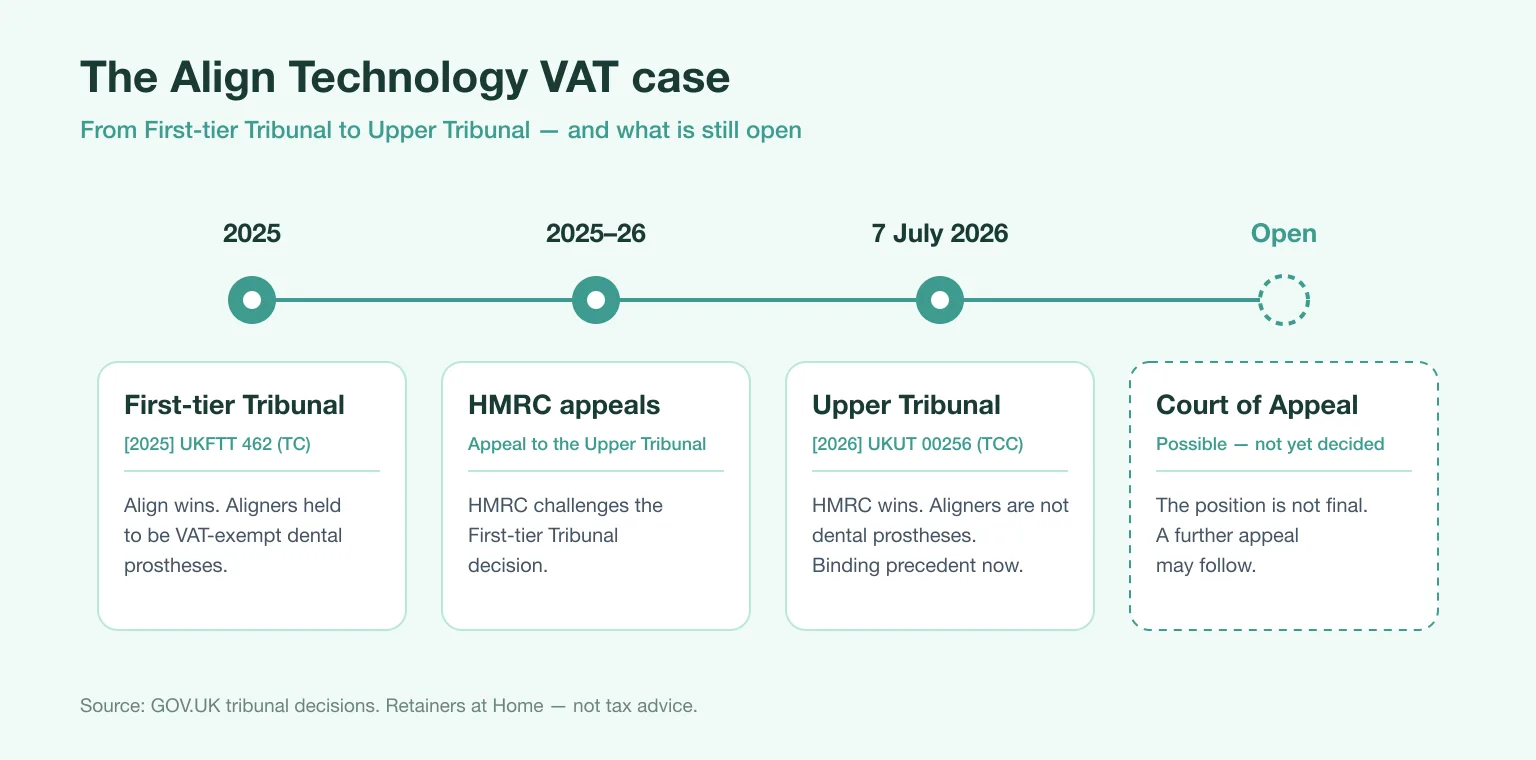
This distinction matters because the UK VAT system can treat the clinical service and the physical appliance differently. A dentist's qualifying dental care may remain exempt, while a laboratory's supply of a particular appliance may be taxable. The ruling does not mean patients must pay VAT on every dental appointment, nor does it automatically make every dental product standard-rated.
Prosthesis, or appliance? The test that now matters
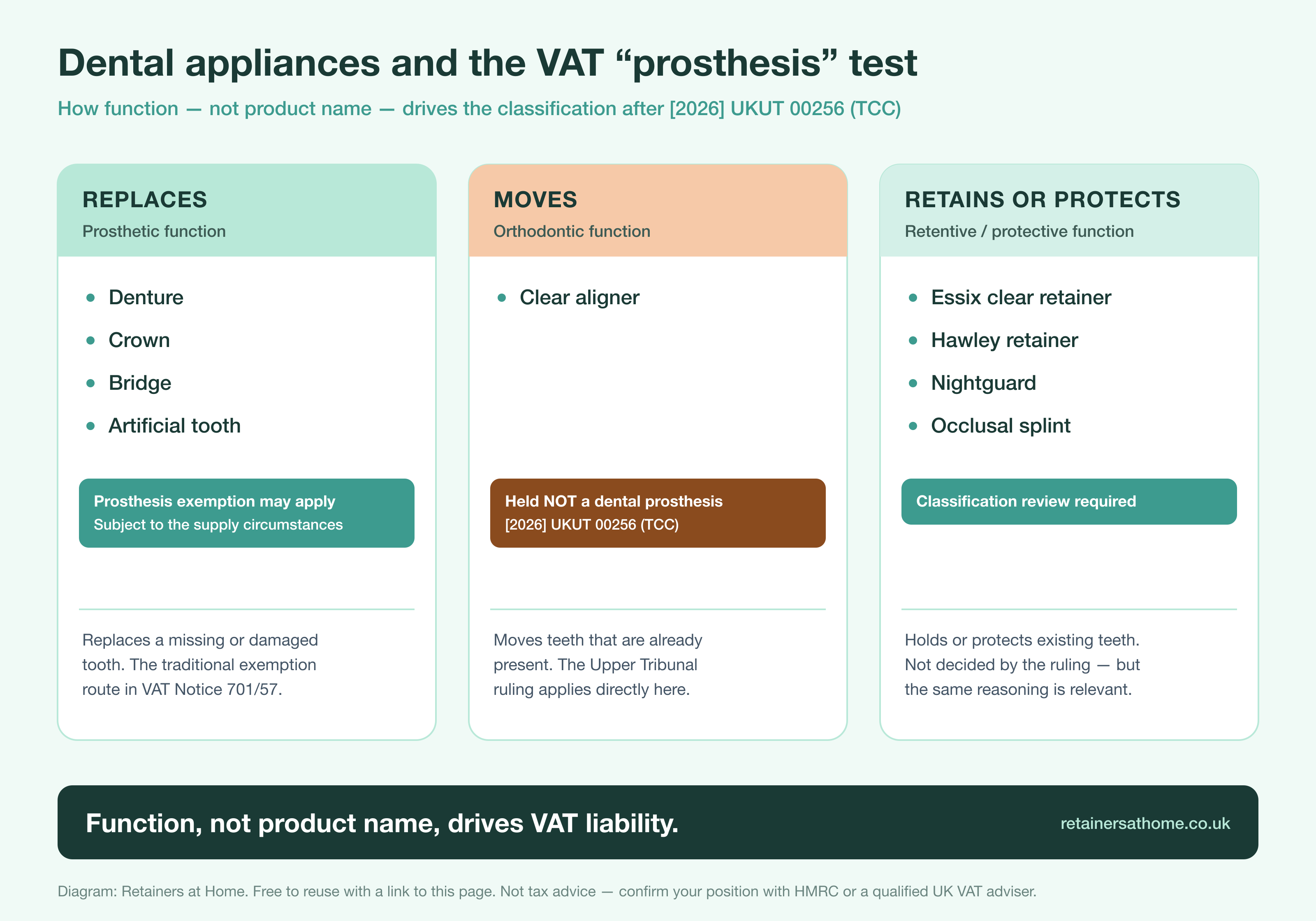
The most useful way to read the judgment is as a functional test. Group dental appliances by what they physically do to the mouth, and the VAT question becomes much clearer than it looks when you group them by product name.
 Tap to enlarge Click to enlarge
 | Function | Examples | Position after the 2026 ruling |
|---|---|---|
| Replaces Prosthetic | Denture, crown, bridge, artificial tooth | Replaces a missing or damaged tooth. The traditional prosthesis exemption route described in VAT Notice 701/57, subject to the supply circumstances. |
| Moves Orthodontic | Clear aligner | Moves teeth that are already present. Held NOT to be a dental prosthesis in [2026] UKUT 00256 (TCC). The ruling applies directly to this category. |
| Retains or protects Retentive / protective | Essix clear retainer, Hawley retainer, nightguard, occlusal splint | Holds existing teeth in position or protects them. Not decided by the ruling, but the same functional reasoning is relevant — classification review required. |
This is a practical framework for structuring a review, not a binding classification. "Retainer", "aligner", "splint" and "appliance" do not by themselves determine VAT liability.
Are dental retainers VAT exempt or standard-rated?
There is no safe basis for saying that every UK dental retainer is automatically exempt, or automatically subject to VAT. The answer depends on the product's design and function, the contractual supply chain, the status of the supplier and the circumstances in which it is provided.
HMRC's VAT Notice 701/57 says that a dentist, dental care professional or dental technician may exempt supplies of dental care and treatment, drugs or appliances provided in the course of dental care and treatment, and dental prostheses. HMRC gives examples of traditional prostheses including dentures, artificial teeth, crowns, bridges and plates. The same notice says that items other than prostheses which are separable from dental treatment supplied to a patient will usually be standard-rated.
Applied product by product, that produces a set of questions rather than a set of answers:
| Product or supply | The VAT question | Why it needs review |
|---|---|---|
| Removable post-orthodontic retainer | Is it a retentive appliance rather than a prosthesis? | It normally holds existing teeth in position and does not replace a missing tooth. |
| Clear orthodontic aligner | Settled by the 2026 ruling — not a dental prosthesis. | The judgment is directly about aligners of this kind. |
| Crown, bridge, denture or artificial tooth | Does it fall within the traditional prosthesis exemption? | These replace missing or damaged tooth structure, subject to the exact supply circumstances. |
| Retainer containing a temporary tooth or pontic | Is the product partly or wholly replacing a missing tooth? | Function and design may differ materially from an ordinary post-treatment retainer. |
| Mouthguard, nightguard or occlusal splint | Is it protective rather than prosthetic? | Protecting existing teeth is not the same as replacing a missing or damaged body part. |
What does this mean for British consumers?
For most patients, the effect of a VAT reclassification shows up in pricing and invoices rather than in the dental treatment itself. Where a supplier concludes that an appliance is a taxable supply and is VAT registered, it may need to charge VAT at the applicable rate. The current UK standard rate is 20%.
A business may display a VAT-inclusive price, as consumer-facing retailers normally do, or show the net price and VAT separately on an invoice. When comparing providers, compare like with like: check whether the quoted price is the total you will pay, whether an impression kit and delivery are included, and whether the price is for one arch, a pair or a replacement service.
One point is worth stating plainly. A change in VAT treatment is a tax classification, not a clinical quality rating. It tells you nothing about whether an appliance is well made or suitable for you. Those questions are answered by whether the provider uses an appropriately regulated dental laboratory, what material the retainer is made from, how impressions or scans are handled, and what support exists if the appliance does not fit.
If you are replacing a lost or damaged retainer, our guide to replacement retainers and whether you need to see a dentist covers the practical questions. For a broader price comparison across dentists, orthodontists and online providers, see how much retainers cost in the UK.
What the ruling means for UK dental laboratories
Laboratories should treat the judgment as a prompt for a product-by-product review, not as a reason to apply one rate to every appliance. A defensible review documents each product's intended use, construction and function, whether it replaces a missing or damaged tooth, and whether it is supplied directly to a patient, to a dentist, or as part of a wider clinical service.
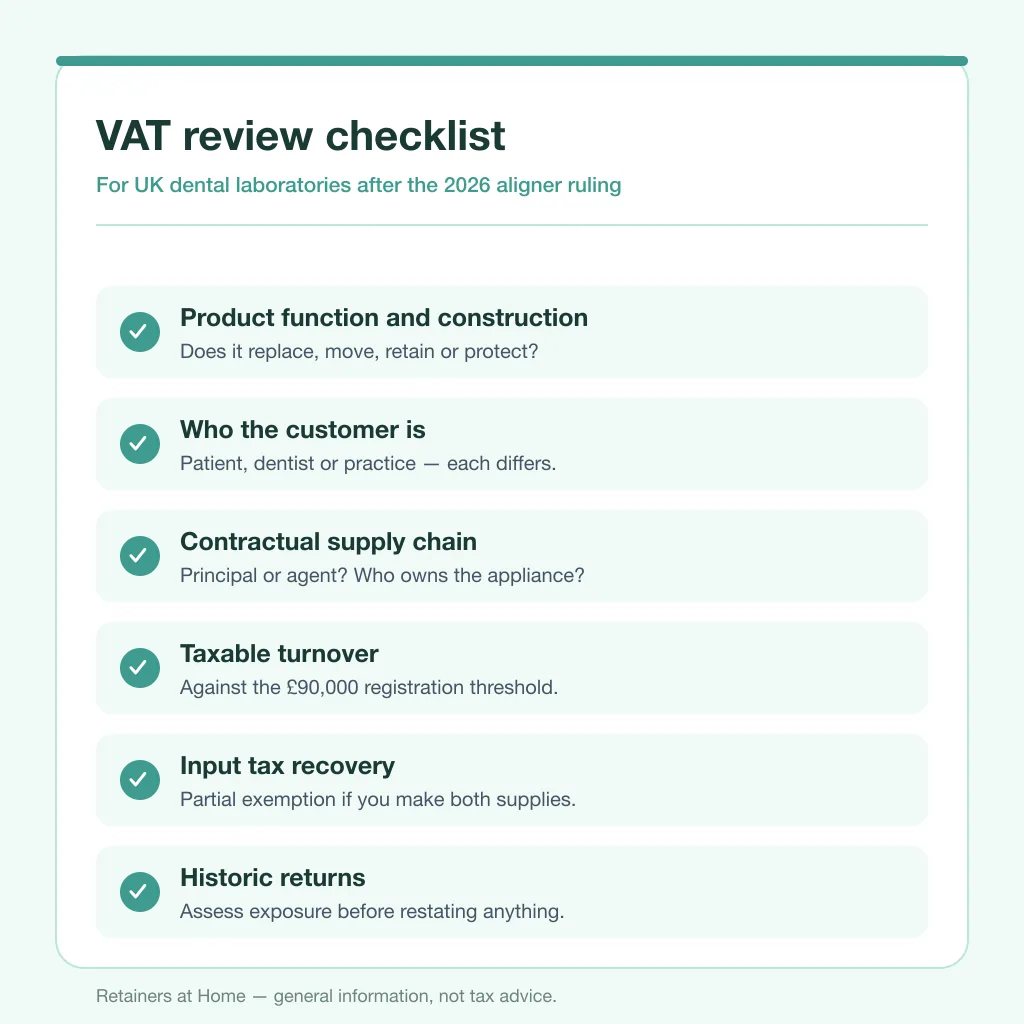
The commercial consequences can be significant in both directions. Moving a product from exempt to standard-rated may increase the price paid by practices or patients who cannot recover VAT. But a VAT-registered laboratory may also be able to recover input VAT that was previously restricted because it was making exempt supplies. HMRC explains that input tax relating to exempt supplies normally cannot be deducted, and that businesses making both taxable and exempt supplies may need to apply partial-exemption rules.
Laboratories that have historically treated relevant supplies as exempt should also review their taxable turnover. A business must register when its taxable turnover for the previous 12 months exceeds £90,000, subject to the detailed rules and exceptions; the deregistration threshold sits at £88,000. A reclassification that converts exempt income into taxable turnover can therefore trigger a registration obligation that did not previously exist.
A proper review should cover pricing models, customer contracts, invoices, accounting codes, VAT returns, input-tax recovery and the possibility of historic exposure. The historic position depends on the facts, the date any liability arose, the business's records and the applicable assessment rules. It should not be estimated from a product label or from another laboratory's approach.
Does the ruling affect dentist and orthodontist fees?
Not in the same way. The decision concerned the VAT status of aligners supplied by Align Technology. It did not remove the general exemption for qualifying dental care supplied by an appropriately registered professional. HMRC guidance continues to distinguish exempt dental care and treatment from goods that are separable from treatment and are usually standard-rated.
The important point is that a dental practice may be making several different supplies for VAT purposes at once. A clinical examination, diagnosis or course of treatment may need to be considered separately from an appliance manufactured by a laboratory. Practices should review how they describe and invoice bundled treatment, laboratory charges and appliances, particularly where the customer cannot recover VAT.
The correct result may depend on whether the practice is acting as principal or agent, who owns the appliance before delivery, how the laboratory charge is contracted, and whether the appliance is supplied in the course of qualifying dental care. Dental professionals should obtain specific advice before changing patient pricing.
How the profession has responded
The reaction within UK dentistry has focused less on aligners themselves than on what the reasoning might reach next. The British Orthodontic Society has publicly raised concern that removing the exemption from orthodontic aligners may signal a broader reassessment of how orthodontic appliances are treated for VAT — which is precisely why retainers, splints and nightguards are now being looked at again by laboratories that had not previously questioned their treatment.
That concern is about direction of travel rather than settled law. No decision has extended the reasoning to retainers. But the practical consequence is the same: a laboratory that cannot explain, product by product, why it treats a given appliance as exempt is in a weaker position than one that can.
Key takeaways on VAT and dental retainers
The 2026 Upper Tribunal ruling decided that the Invisalign clear aligners in that case were not VAT-exempt dental prostheses. It did not create a universal rule that every dental retainer is standard-rated.
The reasoning is functional: replacing a missing or damaged tooth is different from moving, retaining or protecting teeth that are already present.
The decision reversed a First-tier Tribunal ruling that had gone the other way, and a further appeal remains possible. Treat the position as authoritative, not final.
For patients, any practical impact appears in advertised prices and invoices. VAT treatment says nothing about clinical quality.
For laboratories and practices, the responsible step is a documented, product-by-product review covering function, supply chain, registration, input-tax recovery, invoicing and historic returns.
Frequently asked questions
Are dental retainers VAT exempt in the UK?
There is no single answer that covers every retainer. VAT liability depends on what the appliance does, who supplies it and to whom. HMRC's VAT Notice 701/57 exempts dental prostheses — items that replace missing or damaged teeth, such as dentures, crowns and bridges. Most removable retainers hold existing teeth in position rather than replacing anything, so they do not obviously fall within that description. The 2026 Upper Tribunal ruling did not decide the point for retainers, but its reasoning makes the distinction between replacing and retaining far more important.
What did the 2026 clear aligner VAT ruling decide?
On 7 July 2026 the Upper Tribunal allowed HMRC's appeal in HM Revenue and Customs v Align Technology Switzerland GmbH, [2026] UKUT 00256 (TCC). It held that Invisalign clear aligners are not dental prostheses within Items 2 and 2A of Group 7 to Schedule 9 of the Value Added Tax Act 1994. The Tribunal's reasoning was functional: a prosthesis replaces a missing or damaged part of the body, whereas an aligner moves teeth that are already present.
Does the ruling change what I pay my dentist?
Not directly. The decision concerned the VAT status of aligners supplied by a manufacturer. It did not remove the exemption for qualifying dental care supplied by a registered dental professional. HMRC guidance continues to distinguish exempt dental care and treatment from goods that are separable from that treatment, which are usually standard-rated. A practice may still need to review how it invoices bundled treatment, laboratory charges and appliances.
Is the 2026 aligner VAT ruling final?
The Upper Tribunal decision is binding precedent now, but the position is not necessarily settled. The First-tier Tribunal had previously decided the same case in Align's favour, and a further appeal to the Court of Appeal remains possible. Businesses should treat the current position as authoritative while recognising that it could change.
About Retainers at Home
Retainers at Home supplies custom clear retainers made in a UK dental laboratory, ordered online from impressions you take at home. You can see how custom clear retainers work, read the at-home dental impression instructions, or browse the clear retainer FAQs for questions about fit, delivery and aftercare.
Custom clear retainers, made in a UK dental lab
Take your impressions at home. We make your retainers and post them to your door.
Shop Clear RetainersSources
- [2026] UKUT 00256 (TCC) HM Revenue and Customs v Align Technology Switzerland GmbH — GOV.UK
- Health professionals and pharmaceutical products (VAT Notice 701/57) — GOV.UK
- VAT rates on different goods and services — GOV.UK
- Register for VAT — GOV.UK
Last reviewed 2 September 2026. VAT guidance and case-law interpretation can change. This page is reviewed when HMRC publishes further clarification or the case progresses.